Private Aviation
9 min readGround transport for private aviation in London
Ground transport for private aviation runs on different information from a scheduled airport transfer. Tail numbers replace flight numbers, and the handling agent sets the clock.
- Identifier
- Aircraft registration rather than a flight number
- Access
- Landside at the private terminal by default
- Airside
- By airport permission and permit, arranged case by case
- Required
- Registration, handling agent and expected movement time
In Short
Private aviation around London is served by a small group of airports and a larger group of fixed base operators, the handling companies that run the private terminals themselves. A chauffeur transfer to or from one of them is operationally simpler than a scheduled airport run in some respects and considerably more particular in others.
Simpler, because there is no arrivals hall, no baggage belt and usually a walk of only a few metres between aircraft and terminal. More particular, because access is controlled by the handling agent, movement times stay fluid until close to the day, and the information a chauffeur needs is not the information a scheduled transfer requires.
This guide explains how the pieces fit together: what a fixed base operator does, what landside and airside actually mean for a vehicle, which airports serve the capital, and what to tell your operator so that the car is in the right place when the aircraft is.

01Section
What a fixed base operator does
A fixed base operator handles the aircraft and its passengers on the ground. It provides the private terminal, arranges fuel, files the paperwork, manages border and customs formalities where they apply, and coordinates the aircraft's movement to and from its stand. Most private aviation airports host more than one such company.
For a passenger, the terminal is the whole airport experience. It is typically a small building with a lounge, a security process appropriate to private aviation, and a short walk or short drive out to the aircraft. Arrival to airborne can be a matter of minutes rather than the hours a scheduled departure demands.
Ground transport interacts with the handling agent rather than with the airport authority. The handler knows the stand, the expected movement time and the access arrangements, and it is the handler to whom a chauffeur's arrival is notified. We describe how these terminals typically operate; we claim no partnership or preferential arrangement with any of them.

02Section
Landside and airside
Landside means the public side of the fence: the terminal car park, the entrance and the set-down area. Every private aviation transfer takes place landside by default, and for the overwhelming majority of movements that is entirely sufficient. The walk from the terminal door out to the aircraft is short.
Airside means beyond the security line, on the apron itself. A vehicle driven to the aircraft steps requires the airport's permission, an airside vehicle permit, and in most cases a driver holding an airside driving qualification specific to that airport. It is arranged through the handling agent, case by case, and granted by exception rather than as a matter of routine.
The practical position is straightforward. Assume a landside collection at the terminal. Where airside access is genuinely required, raise it early with the handling agent and the operator so that permission can be sought properly. Nobody can promise ramp access in advance, and anyone who does should be treated with caution.
- Landside: the terminal entrance and car park, the normal arrangement
- Airside: the apron, by airport permission and permit only
- Airside requests go through the handling agent, well in advance
03Section
The main London-area private aviation airports
Farnborough in Hampshire is a dedicated business aviation airport, reached from the M3 at junction 4 and roughly an hour from central London outside peak hours. London Biggin Hill sits to the south-east, off the A233, and serves the City and south London well. Both are built entirely around private movements.
London Luton and London Stansted handle substantial private aviation alongside their scheduled traffic, each with several handling agents operating separate private terminals. Luton is reached from the M1 at junction 10 and Stansted from the M11 at junction 8. Both suit the north of London and the home counties. Neither approach is difficult, but each terminal sits in its own part of a large site.
London City Airport, in the Royal Docks, accepts business aircraft within its steep-approach and runway constraints and is the closest option to Canary Wharf and the Square Mile. RAF Northolt in west London accepts civil business aviation on a permit basis under Ministry of Defence control, with restrictions of its own.
- Farnborough: dedicated business aviation, M3 junction 4
- Biggin Hill: south-east London, approached from the A233
- Luton and Stansted: private terminals alongside scheduled operations
- London City: the closest to Canary Wharf and the Square Mile
- Northolt: civil business aviation under MoD control, by permit
04Section
Tail numbers and what to supply
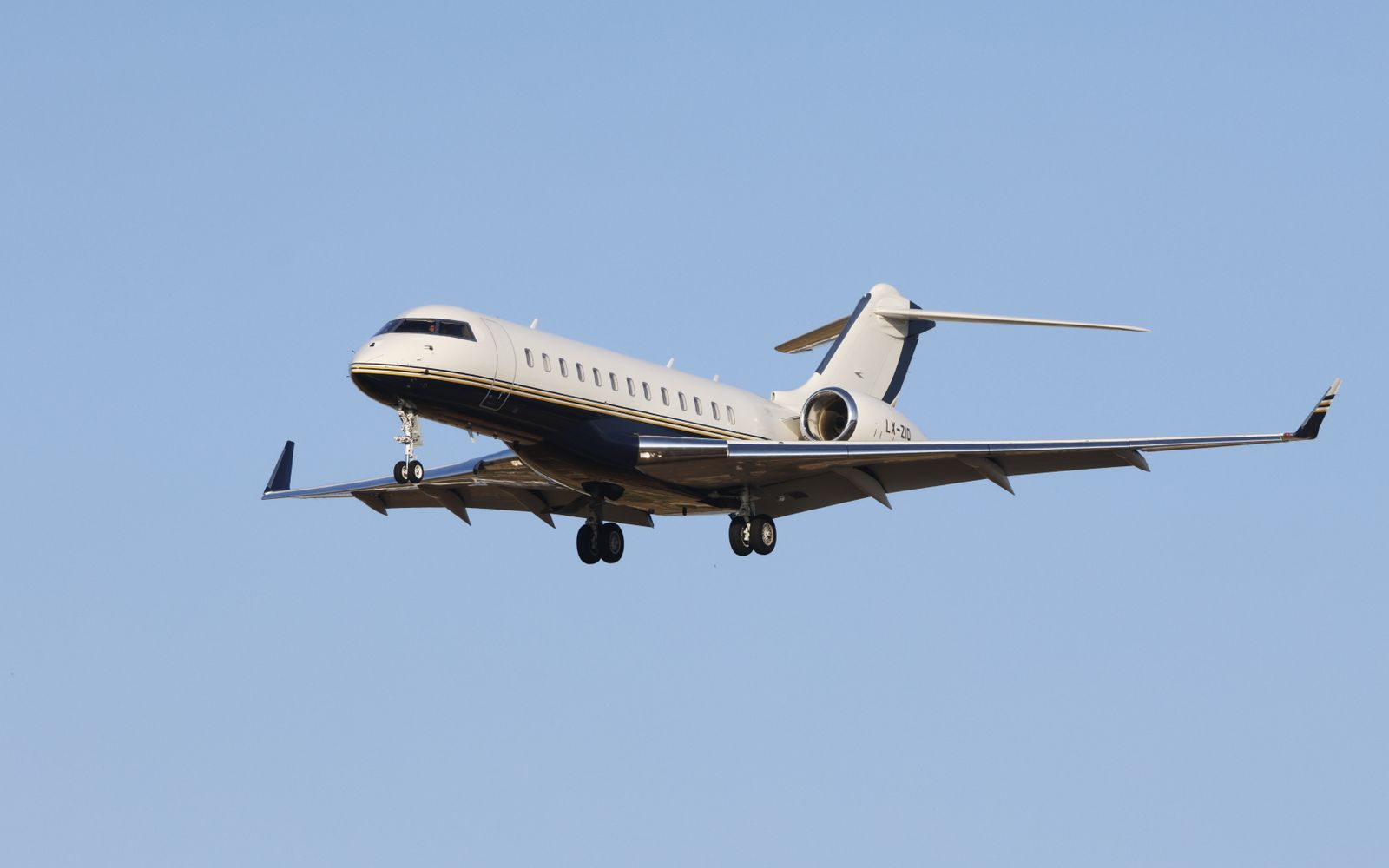
A private aircraft carries a registration, commonly called a tail number, rather than a flight number. It is the identifier the handling agent works to and the one a chauffeur team records. Supply it when booking alongside the name of the handler, because a single airport may host several and their terminals are not adjacent to one another.
Movement times for private flights firm up later than scheduled ones. A departure slot may move by an hour on the morning itself, and an arrival may be earlier than planned where the routing is favourable. Expected times are monitored, and the handling agent remains the reference point whenever they change.
The information that makes a private aviation transfer work is short: registration, handling agent, expected movement time, passenger count and luggage. With those five items a chauffeur team can plan around almost any change. Without the handler name in particular, a vehicle can end up at the correct airport and the wrong building.

05Section
Timing around handling
For arrivals, the useful question is not when the aircraft lands but when it reaches its stand and the passengers reach the terminal. At a quiet business aviation airport that gap can be a handful of minutes. Where border formalities apply it runs longer, and it varies with the origin of the flight.
For departures, the handling agent states a terminal arrival time, usually a modest interval ahead of the planned departure. It is far shorter than a scheduled airline check-in and it is a genuine deadline rather than a padded one, because the aircraft's slot depends on it. Work the road timing backwards from that figure.
Traffic remains the largest variable in the whole chain. Farnborough by way of the M3, Luton by way of the M1 and Biggin Hill by way of the A21 and A233 are all straightforward outside peak hours and all capable of adding half an hour or more within them. Depart earlier rather than driving harder.

06Section
Crew transport
Flight crew frequently need their own transport, and it runs to a different timetable from the passengers. Crew usually arrive at the airport well before the principals and leave after them, and on a night stop they need a hotel transfer at each end plus a return to the aircraft the following morning.
Crew movements are ordinarily booked by the aircraft operator or the flight department rather than by the passengers, and they are often arranged at short notice. The requirements are modest: a saloon or an MPV depending on numbers, room for flight bags and cases, and a chauffeur who understands that the schedule moves with the aircraft.
Where one team handles both principal and crew movements, the coordination is simpler. A single point of contact holds the whole picture, and a change to the aircraft's timing propagates to every vehicle at once rather than reaching one and missing another. On a night stop with an early departure the next day, that consistency is worth more than any amount of individual efficiency.

07Section
Departures from a private terminal
A departure is the simplest movement in private aviation. The vehicle draws up at the terminal entrance, luggage is handed to the handling agent's staff, and the passengers move through to the lounge. There is no queue for a check-in desk and the process is measured in minutes rather than in hours.
The chauffeur will normally wait until the aircraft has departed, or at least until the passengers are through, in case a delay or a change sends them back out. That is a reasonable default on private aviation work, where plans move more often and later than they do on scheduled flights.
For an onward connection, the practical detail is who takes the luggage and where. Confirm with the handling agent whether the vehicle sets down at the main entrance or at a separate luggage point, since arrangements differ between terminals at the same airport. Where the party is large, agreeing that beforehand saves a slow shuffle across a small forecourt.

08Section
Vehicles and luggage for private aviation
Vehicle choice follows the same logic as any airport transfer, with one addition: private aircraft carry their own luggage constraints, and passengers therefore sometimes arrive with far less than they would on a scheduled flight and occasionally with considerably more. A light aircraft restricts baggage tightly; a large-cabin jet does not, and a party stepping off one may fill a saloon boot twice over.
For two passengers a saloon is normally correct. For four or more, or where the party includes crew, an MPV keeps everybody together in one vehicle. Where several aircraft arrive within a short window for the same event, a small convoy is easier to marshal than a sequence of individual arrivals.
Specific make, model, colour and specification remain subject to availability and confirmation. What is worth settling at the booking stage is capacity, since a set-down at a private terminal leaves no useful margin for rearranging a load on the kerb. Give the passenger count and the case count, and the vehicle class follows without further discussion.
Reader Questions
Answered plainly.
If something here is not covered, send the question over. A direct answer is faster than a form.
Only where the airport grants permission. Airside access requires an airside vehicle permit and a driver qualified for that specific airport, and it is arranged through the handling agent case by case. The standard arrangement is a landside collection at the private terminal, where the walk from the aircraft is short in any event.
The aircraft registration, the name of the handling agent, the expected movement time, the passenger count and the luggage. The handler matters as much as the airport, because one airport may operate several private terminals in different locations across the site.
Farnborough and Biggin Hill are dedicated business aviation airports. Luton and Stansted operate private terminals alongside their scheduled traffic. London City accepts business aircraft within its approach and runway constraints, and Northolt handles civil business aviation on a permit basis.
Work backwards from the terminal arrival time the handling agent gives you, which is usually a short interval before the planned departure. It is far shorter than an airline check-in but it is a real deadline. Add road margin for the peak rather than trimming it away.
Yes, and it is commonly requested. Crew transfers run to their own timetable, generally arriving before the passengers and departing after them, with hotel transfers on a night stop. Handling both under one point of contact means a change to the aircraft timing reaches every vehicle at once.
No, and any operator claiming one is worth questioning. Chauffeur access to a private terminal works through the handling agent on the day, in the same way as any other ground transport arrangement. What matters is that your operator knows how each terminal is laid out and how it is approached.